CAN LOWER TAXES CREATE HIGHER REVENUE?
A BOLD NEW TAX VISION FOR PAKISTAN
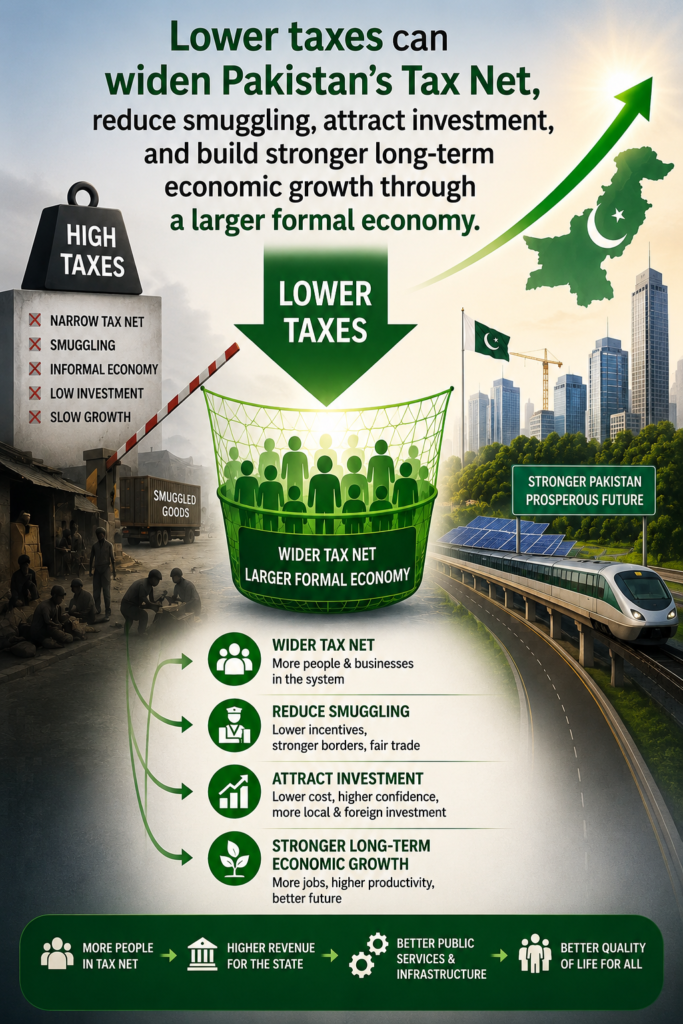
A lower Tax Rate can widen the Tax Net in Pakistan, lift the economy, and raise long-run revenue through phased reform.
Pakistan does not need another punishing Tax Rate shock. Instead, it needs a smarter tax map having benevolent Tax Reforms. Today, the state squeezes the same filers harder. Meanwhile, much of the wider economy stays informal and under-documented. That approach can collect cash today. However, it often weakens tomorrow’s Tax Net. Therefore, Pakistan should reverse that logic NOW.
Why Pakistan Needs a New Tax Idea?
Pakistan’s economy is recovering, but growth remains modest. Official data put FY2025’s growth at 2.68%. Investment reached only 13.8% of GDP. The state also needs stable revenue. Yet the World Bank sees tax capacity above 22% of GDP. However, it also warns against extracting more from a stagnant economy. That means design matters as much as rates.
Pakistan’s current tax system still depends heavily on squeezing existing taxpayers. For example, imports supplied 58.5% of sales tax in FY2025. Customs duties and para-tariffs also shape incentives. That design is easy at the border. However, it is weaker inside the domestic market. It taxes visibility, not real capacity.
That matters because a narrow Tax Net creates unhealthy habits. Honest businesses pay more than hidden competitors. Small producers stay divided to avoid attention. Retailers avoid proper documentation. Importers understate values to reduce taxes. Smugglers benefit from bigger price differences. As a result, the formal sector becomes weaker. This happens partly because Pakistan’s tax system is fragmented and import duties remain exceedingly high.
Lower Taxes Increase Government Revenue
The idea is not that simple.
A moderate Tax Rate can change business behavior positively. First, it reduces the benefit of tax evasion. Next, it decreases the price advantage of smuggled goods. Businesses also feel less pressure while issuing invoices and paying taxes. Legal production becomes more attractive and profitable. As a result, more businesses may join the Tax Net. Evidence from many countries shows that extremely high duties and complicated taxes often push trade toward illegal channels.
Lower tax rates may reduce revenue briefly. However, reasonable taxes encourage businesses to work legally. More traders join the formal economy. Retailers issue invoices more openly. Importers declare correct values more honestly. As a result, the Tax Net expands significantly. Therefore, wider participation can maintain or even increase overall tax collection over time.
This is the real difference between the two systems. A high-tax system keeps targeting the same visible taxpayers. In contrast, a moderate and broad-based system brings more hidden businesses into the formal economy. The first system creates fear, avoidance, and corruption. The second system encourages compliance, growth, and expansion. Therefore, the second model can collect more revenue over time.
Lower Taxes, Stronger Compliance
Research also supports this approach. Better tax administration reduces tax evasion and improves compliance. Public trust matters as well. Simple tax systems are easier for businesses to follow. Fair tax rates also improve willingness to pay taxes. Strong audits further strengthen the system. In fact, an IMF working paper says stronger administration can reduce VAT lo
sses and increase long-term tax collection.
Pakistan already shows signs of improvement through better documentation. According to the Federal Board of Revenue, Pakistan’s tax-to-GDP ratio reached 10.3% in FY2025. The number of tax return filers also increased from 4 million to around 7 million within three years. More retailers now use the point-of-sale system. Electronic invoicing has also become compulsory for registered taxpayers. In addition, the track-and-trace system now targets fraud and illegal trade. Therefore, these reforms can produce even better results if tax rates become more practical and business friendly.
What the global examples show
Singapore offers an important lesson. The corporate Tax Rate is 17%. The country also provides stable policies, digital systems, and clear business rules. Companies can file taxes online very easily. In 2025, Singapore continued attracting major investments and creating new jobs. Low taxes alone did not create this success. However, they helped build a trusted and business-friendly economy.
Estonia provides another strong example. Companies pay income tax only when profits are distributed. If profits remain invested in the business; tax payment is delayed. In addition, all tax filing happens online. Many businesses complete tax returns within minutes. This digital system makes compliance easier and faster. Therefore, a moderate Tax Rate works better when the process remains simple.
Hong Kong also shows the benefits of a simple tax system. Corporate profit tax stands at 16.5%, while salaries tax is capped at 15%. The city does not impose value-added or sales tax. The system stays predictable and transparent. As a result, businesses spend less time avoiding taxes and more time growing.
United Arab Emirates offers another useful example. There is only 5% VAT there. Corporate tax remains 0% up to a certain limit and rises to 9% above that level. This is not a zero-tax system. Instead, it is a balanced and moderate approach with clear rules. Therefore, it proves that lower taxes can work successfully alongside modern tax administration.
Ireland is equally important. Its 12.5% corporate Tax Rate helped attract global investment for many years. In 2024, IDA Ireland reported 234 investment projects with future job opportunities attached. Employment in supported companies remained above 300,000. Tax policy was not the only reason behind this success. However, competitive rates helped expand the formal economy and investment base.
None of these countries can be copied exactly by Pakistan. Their institutions, history, and economic conditions are different. Still, they all share one important lesson. Moderate tax rates work best with simple rules, digital systems, and strong enforcement. Pakistan can apply the same principle according to its own economic realities.
A practical five-year plan for Pakistan
Pakistan should not reduce all taxes abruptly. That approach would be dangerous and risky. Instead, the country should lower taxes gradually over five years. The target should be moderate tax levels between 10% and 15% on major business taxes, especially sales tax, withholding taxes, and some import duties. At the same time, the Tax Net must expand quickly.
In the first year, Pakistan should stop introducing new tax increases. Then, the government should reduce the sales Tax Rate from 18% to 16%. It should also reduce the most burdensome taxes on documented transactions. Alongside this, the government should enforce electronic invoicing, expand POS systems, and connect CNIC-based data across departments and agencies.
During the second and third years, the sales Tax Rate should gradually move toward 15%. Import duties and para-tariffs should also become simpler with fewer categories. Export industries should face fewer delays and lower costs. Tax refunds should become automatic and faster. In addition, the government should replace unnecessary harassment with smart risk-based audits. This step would especially support exporters, industries, and formal retailers.
In the fourth and fifth years, Pakistan should reduce the main Tax Rate on trade and consumption closer to 12% or 13%. However, higher excise taxes can remain on harmful products such as tobacco or luxury goods.
Controlled Tax Reform, Not Emotional Policy
By that stage, businesses would have gained confidence in the system, and the fear of joining the Tax Net would disappear. More retailers, transport businesses, real estate activities, and agricultural income would gradually become documented. At the same time, federal and provincial tax systems should move toward one unified digital portal. Land records should also become fully digitized to improve transparency and reduce corruption.
This reform plan should remain carefully controlled. Every tax reduction should depend on clear results. The number of tax filers must increase. Documented transactions must grow steadily. Revenue from the wider Tax Net should compensate for lower tax rates. If these targets are not achieved, the next tax cut should stop temporarily. This approach keeps reform practical and disciplined rather than emotional or political. It also matches the IMF’s focus on wider tax collection and stronger compliance instead of relying only on high tax rates.
Why This Reform Is Now Inevitable for Pakistan?
Pakistan cannot continue with the present tax system for long. High taxes have increased business costs. Complicated rules have created confusion. Frequent policy changes have reduced business confidence. Heavy import taxes have also encouraged smuggling and weakened competitiveness. Therefore, Pakistan now needs a simpler and growth-friendly tax system.
A moderate Tax Rate is now necessary for economic growth. Manufacturers need relief from excessive costs and delayed refunds. Retailers need easier compliance rules. Consumers also need lower prices. At the same time, a wider Tax Net can increase government revenue from more businesses instead of pressuring the same taxpayers repeatedly.
This reform is also important for investment. Investors prefer stable and predictable systems. Pakistan already competes with countries offering lower and simpler taxes. It cannot attract investment with uncertainty and excessive taxation. However, a moderate Tax Rate and digital transparency can support industrial growth and new investment. Therefore, this reform is now an economic necessity for Pakistan.
IMF Concerns and Political Resistance
The biggest concern is government revenue. Pakistan is already working under an International Monetary Fund program and cannot afford major revenue losses. This concern is understandable. However, the IMF also wants Pakistan to increase its tax-to-GDP ratio through a wider Tax Net and better compliance. Therefore, gradual tax cuts can still work if the tax base expands properly.
Political resistance will also be strong. Groups enjoying tax exemptions may oppose reform. Informal businesses may resist documentation. Provinces may avoid coordination. Some people also benefit from a complicated system because it creates corruption and unofficial gains. Therefore, strong political leadership will be necessary for successful reform.
The solution is not careless tax reduction. Instead, it should be a balanced national agreement. The government should offer a moderate Tax Rate, while businesses accept full documentation and digital reporting. Provinces should share data with FBR. Tax departments should move from harassment toward digital monitoring and smart enforcement. As a result, smuggling and corruption can decline, while the Tax Net and formal economy continue expanding.
The case for a bold new tax vision
Pakistan should stop focusing only on collecting more taxes from the same limited group of honest taxpayers. Instead, it should focus on making the formal economy easier, fairer, and larger. That is the real path toward stronger and sustainable revenue. A wider Tax Net can produce better results than harsh taxation on a few visible sectors.
This is why gradual tax reduction deserves serious support. It connects revenue growth with economic growth. This approach will rewards legal business activity instead of tax evasion. It also reduces the space for smuggling and undocumented trade. At the same time, it supports industry, investment, and job creation. Most importantly, it can strengthen the state by expanding the economy itself.
A smarter Tax Rate is not simply a benefit for wealthy groups. It is a national economic strategy. If Pakistan reduces taxes gradually, digitizes trade documentation, improves risk-based audits, and expands the Tax Net, it can collect more revenue from a much larger formal economy. That is the real opportunity before Pakistan today.