Federal Budget 2026-27 Pakistan Explained
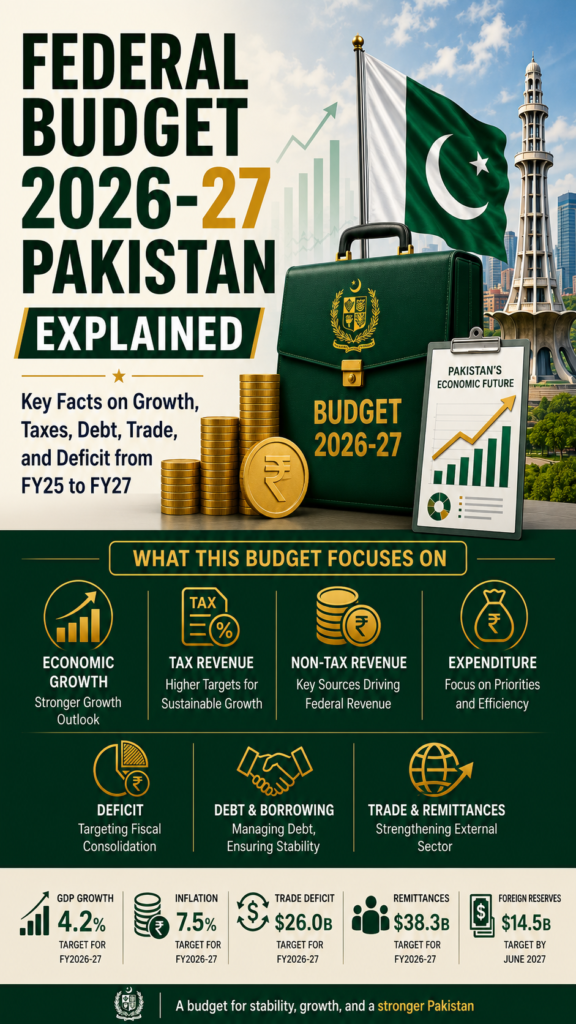
Federal Budget 2026-27 Explained with Pakistan’s Growth, Taxes, Debt, Trade, and Deficit Figures for FY25 to FY27.
Why This Budget Matters
The Federal Budget 2026-27 aims to support economic growth. It stays on the IMF reform path. The budget targets a lower deficit. It raises taxes in some areas. The fiduciary plannig keeps government spending under control. Budget for 2026-27 aims to maintain economic stability while supporting growth and continuing fiscal reforms.
(Disclaimer: Final audited figures do not appear on one single budget table. This article uses the latest official number available for each item.)
The Core Fiscal Picture
The Federal Budget 2026-27 projects gross federal revenue of Rs20.60 trillion, compared with the revised estimate of Rs18.08 trillion in FY2025-26. This represents an increase of about 14.0%.
Total federal expenditure is budgeted at Rs18.77 trillion for FY2026-27, up from the revised estimate of Rs15.64 trillion in FY2025-26. This represents an increase of about 20.0%, reflecting higher spending on interest payments, defence, pensions, grants, and other government priorities.
(Rs. In Trillions)
| Federal Budget Summary | FY2024-25 | FY2025-26 | FY2026-27 |
| Tax Revenue (FBR) | 11.900 | 12.983 | 15.264 |
| Non-Tax Revenue | 4.902 | 5.093 | 5.336 |
| Gross Federal Revenue | 16.802 | 18.076 | 20.600 |
| Less: Provincial Share (NFC) | (6.997) | (7.592) | (8.848) |
| Net Revenue Available to Federal Government | 9.805 | 10.484 | 11.752 |
| Total Expenditure | (17.249) | (15.64) | (18.77) |
| Budget Deficit | (7.444) | (5.16) | (7.02) |
Tax Revenue
The tax side tells the real story. The Federal Budget 2026-27 sets the FBR target at Rs15.264 trillion. It is roughly 17.6 percent above the revised FY2025-26 estimate of Rs12.983 trillion. In plain words, the target looks difficult, but not impossible. It depends on broader compliance and stronger growth.
Non Tax Revenue :
Non-tax revenue in the Federal Budget 2026-27 is driven mainly by the Petroleum Levy and profit transferred by the State Bank of Pakistan (SBP). It also includes constitutional receipts recorded under Article 164, which contribute significantly to the overall non-tax revenue target.
| Major Non-Tax Revenue Source | FY2026-27 Budget (Rs Trillion) |
| Petroleum Levy | 1.677 |
| Profit from the State Bank of Pakistan (SBP) | 1.436 |
| Grants/Receipts from Provinces under Article 164 * | 1.035 |
| Total | 4.141 |
* (The federal government collects the money on behalf of the provinces and then transfers it to them.)
Total Federal Expenditure
Interest payments remain the largest component of federal spending. They account for Rs8.054 trillion in the Federal Budget 2026-27, reflecting the high cost of servicing public debt. Defence is the second-largest spending head, with an allocation of Rs3.000 trillion. Pension payments continue to rise, reaching Rs1.186 trillion. The government has also allocated Rs1.928 trillion for grants and transfers and Rs1.055 trillion for running the civil government.
Overall, federal expenditure is budgeted at Rs18.771 trillion for FY2026-27, higher than the revised estimate of FY2025-26, Rs. 15.64 trillion, indicating increased spending to meet debt obligations, defence needs, and essential government operations.
(Rs. In Trillions)
| Major Spending Head | FY2024-25 | FY2025-26 | FY2026-27 | % of Expenditure |
| Interest Payments | 8.95 | 6.94 | 8.05 | 43% |
| Defence Affairs | 2.18 | 2.59 | 3.00 | 16% |
| Pension | 1.01 | 1.06 | 1.19 | 6% |
| Grants & Transfers | 1.78 | 1.75 | 1.93 | 10% |
| Running Civil Government | 0.97 | 0.98 | 1.06 | 6% |
| Others (after the Top 5 Expenditure | 2.36 | 2.32 | 3.54 | 19% |
| Total Federal Expenditure | 17.25 | 15.64 | 18.77 | 100% |
Provincial Share
Under the NFC Award, provinces are entitled to 57.5% of the net proceeds of the divisible pool taxes. Based on the government’s estimates, transfers to the provinces are budgeted at Rs8.848 trillion for FY2026-27.
Provincial transfers also rose sharply. They were Rs6.997 trillion in the FY2024-25 revised budget. They move to Rs7.592 trillion in FY2025-26 revised estimates. Then they climb to Rs8.848 trillion in the Federal Budget 2026-27.
| Financial Year | Provincial Transfers (Rs Trillion) | Year-on-Year Change |
| FY2024-25 (Revised) | 6.997 | — |
| FY2025-26 (Revised) | 7.592 | +8.5% |
| FY2026-27 (Budget) | 8.848 | +16.5% |
The provinces play an important role in the country’s finances. They must achieve their surplus targets to help keep the budget deficit under control. If they fail, the government may have to borrow more money.
Loan Repayments and New Borrowing
The Federal Budget 2026-27 projects new external financing of Rs6.780 trillion against principal repayments of Rs5.836 trillion. This means that most new foreign borrowing will be used to repay existing loans, leaving only a limited amount available for new financing.
Outstanding Public Debt (Rs. Trillion)
| Debt Category | End-June 2024 | End-June 2025 |
| Total Public Debt | 71.246 | 80.518 |
| Domestic Public Debt | 47.160 | 54.472 |
| External Public Debt | 24.086 | 26.047 |
External Financing and Debt Repayments (FY2026-27)
| Item | Rs Trillion |
| New External Financing | 6.780 |
| Less: Principal Repayments | (5.836) |
| Net Increase in External Financing | 0.944 |
Interest Payment (Rs Trillion)
| Financial Year | Interest Payments | Year-on-Year Change |
| FY2024-25 (Revised) | 8.945 | — |
| FY2025-26 (Revised) | 6.937 | −22.5% |
| FY2026-27 (Budget) | 8.054 | +16.1% |
Interest Payments
Debt service still dominates the state. Interest payments were Rs6.94 trillion in FY2025-26 revised estimates. However, they rise again to Rs8.054 trillion in FY2026-27. Domestic interest payments alone are budgeted at Rs6.983 trillion, while foreign interest payments are budgeted at Rs1.071 trillion. So, interest stays the single biggest spending line.
Interest Payments (Rs. in Trillions)
| Interest Payments | FY2024-25 | FY2025-26 | FY2026-27 |
| Domestic Debt Interest | Rs7.694 | Rs5.922 | Rs6.983 |
| Foreign Debt Interest | Rs1.251 | Rs1.015 | Rs1.071 |
| Total Interest Payments | Rs8.945 | Rs6.937 | Rs8.054 |
Defence Spending
Defence spending also rises. It was Rs2.181 trillion in the FY2024-25 while it is Rs2.588 trillion in FY2025-26 as per revised estimates. It then reaches Rs3.0 trillion in the Federal Budget 2026-27. Reuters also reported the same broad jump in the proposed FY2026-27 defense allocation.
How Will the Government Finance the Federal Deficit?
The Federal Budget 2026-27 projects a federal fiscal deficit of Rs7.019 trillion. The government plans to finance this gap through a combination of domestic and external borrowing rather than by printing money.
| Financing Source | Budget Strategy |
| Domestic Borrowing | The largest share of financing will come from Pakistan Investment Bonds (PIBs), Treasury Bills (MTBs), Sukuk, National Savings Schemes, and other domestic debt instruments. |
| External Financing | The government expects to obtain Rs6.780 trillion in new foreign loans from multilateral institutions, bilateral partners, commercial lenders, and international bonds. |
| Debt Repayments | During the year, the government will repay Rs5.836 trillion of external principal. Therefore, the net external inflow is only about Rs0.944 trillion. |
| Privatization Receipts | The budget also expects proceeds from the privatization of selected state-owned enterprises to reduce borrowing needs. |
| Provincial Surplus | The provinces are expected to receive Rs8.848 trillion under the NFC Award in FY2026-27. After meeting their expenditure commitments, they are projected to generate a combined surplus of Rs1.794 trillion. This provincial surplus helps reduce the country’s overall fiscal deficit to Rs5.226 trillion. |
What Does This Mean?
Tax and non-tax revenues together are insufficient to finance federal expenditure. Instead, it plans to:
- Raise more taxes through improved collection.
- Borrow mainly from domestic financial markets.
- Secure external financing from development partners and other lenders.
- Continue privatization of selected public assets.
- Rely on provinces to achieve their targeted fiscal surplus.
If these measures succeed, the government expects to keep the overall fiscal deficit at 3.6% of GDP, in line with its fiscal consolidation strategy.
Growth, trade, inflation, and reserves & Important Indicators:
- Growth has improved, but it remains modest. Pakistan’s economy grew 3.18 percent in FY2024-25. It posted provisional growth of 3.70 percent in FY2025-26. The official FY2026-27 target is 4.0 percent. Therefore, the government is budgeting for recovery, not a boom.
| Financial Year | GDP Growth Rate | Status |
| FY2024-25 | 3.18% | Actual |
| FY2025-26 | 3.70% | Provisional |
| FY2026-27 | 4.00% | Government Target |
- Inflation improved sharply in FY2024-25, then turned up again. Average CPI inflation was about 4.6 percent in FY2024-25, and official survey data showed 4.7 percent for July-April FY2025. However, in June 2026 CPI inflation was 11.0 percent year on year. For FY2026-27, the government is targeting average inflation of 8.2 percent. So, the inflation fight is not over.
| Financial Year | Average Inflation (CPI) | Status |
| FY2024-25 | 4.6% | Actual |
| FY2025-26 | 4.7% | July–April Average |
| June 2026 | 11.0% | Year-on-Year CPI |
| FY2026-27 | 8.2% | Government Target |
June 2026 represents year-on-year CPI inflation, whereas the other figures are annual or period averages.
Pakistan’s Trade Performance
Pakistan’s trade deficit is expected to widen in FY2026-27. Although the government aims to increase exports to US$32.90 billion, imports are projected to rise to US$70.00 billion. As a result, the trade deficit may increase to about US$37.10 billion, highlighting the need for stronger export growth and prudent import management.
| Trade Indicator (US$ Billion) | FY2024-25 | FY2025-26 * | FY2026-27 Target |
| Goods Exports | 32.04 | 22.70 | 32.90 |
| Goods Imports | 58.36 | 50.70 | 70.00 |
| Trade Balance | (26.32) | (28.00) | (37.10) |
(* FY2025-26 figures cover July–March only and are not directly comparable with the full-year figures.)
Workers’ Remittances
Workers’ remittances remain a vital source of foreign exchange for Pakistan. They reached US$38.30 billion in FY2024-25 and had already totaled US$38.10 billion during July–May FY2025-26. The government expects remittances to rise further to US$42.40 billion in FY2026-27, helping support the external account and foreign exchange reserves.
| Remittances (US$ Billion) | FY2024-25 | FY2025-26 | FY2026-27 Target |
| Workers’ Remittances | 38.30 | 38.10 | 42.40 |
Foreign Exchange Reserves
Pakistan’s foreign exchange reserves have improved over the past year. However, the Federal Budget 2026-27 does not set a formal year-end reserves target. Official policy discussions suggest that reserves are expected to remain above US$18 billion, with the potential to approach US$20 billion by the end of 2026, subject to continued external financing and stable economic conditions.
| Foreign Exchange Reserves (US$ Billion) | Amount | Reference Period |
| Gross Official Reserves | 14.5 | End-June 2025 (IMF) |
| Total Foreign Exchange Reserves | 22.6 | Mid-May 2026 (Economic Survey) |
| Total Foreign Exchange Reserves | 22.0 | 24 June 2026 (SBP) |
| FY2026-27 Official Budget Target | Not specified | — |
| Policy Outlook | Above 18.0, with a possible rise toward 20.0 | End-2026 (Official policy discussions) |
Key Takeaways from the Federal Budget 2026-27
- First, revenue must do heavy lifting. The state wants a much bigger tax haul. However, growth is still moderate. That creates pressure on compliance, not just rates. If tax collection slips, the deficit path weakens fast.
- Second, debt still shapes almost every choice. Interest costs remain huge. Principal repayments are rising. In addition, external financing brings only a limited net gain after repayments. That is why the budget offers little room for broad relief.
- Third, the external sector will decide how stable FY2026-27 feels. Exports need to rise. Remittances must stay strong. Reserves must hold. Otherwise, inflation and the rupee will face pressure again.
- In one line, the Federal Budget 2026-27 is a disciplined budget. It aims for steadier growth, lower deficits, and stronger external buffers. However, it still leans heavily on tax delivery, provincial surpluses, and remittance support. If those three pieces hold, the budget can stabilize Pakistan further. If they fail, the margin for error looks very small.